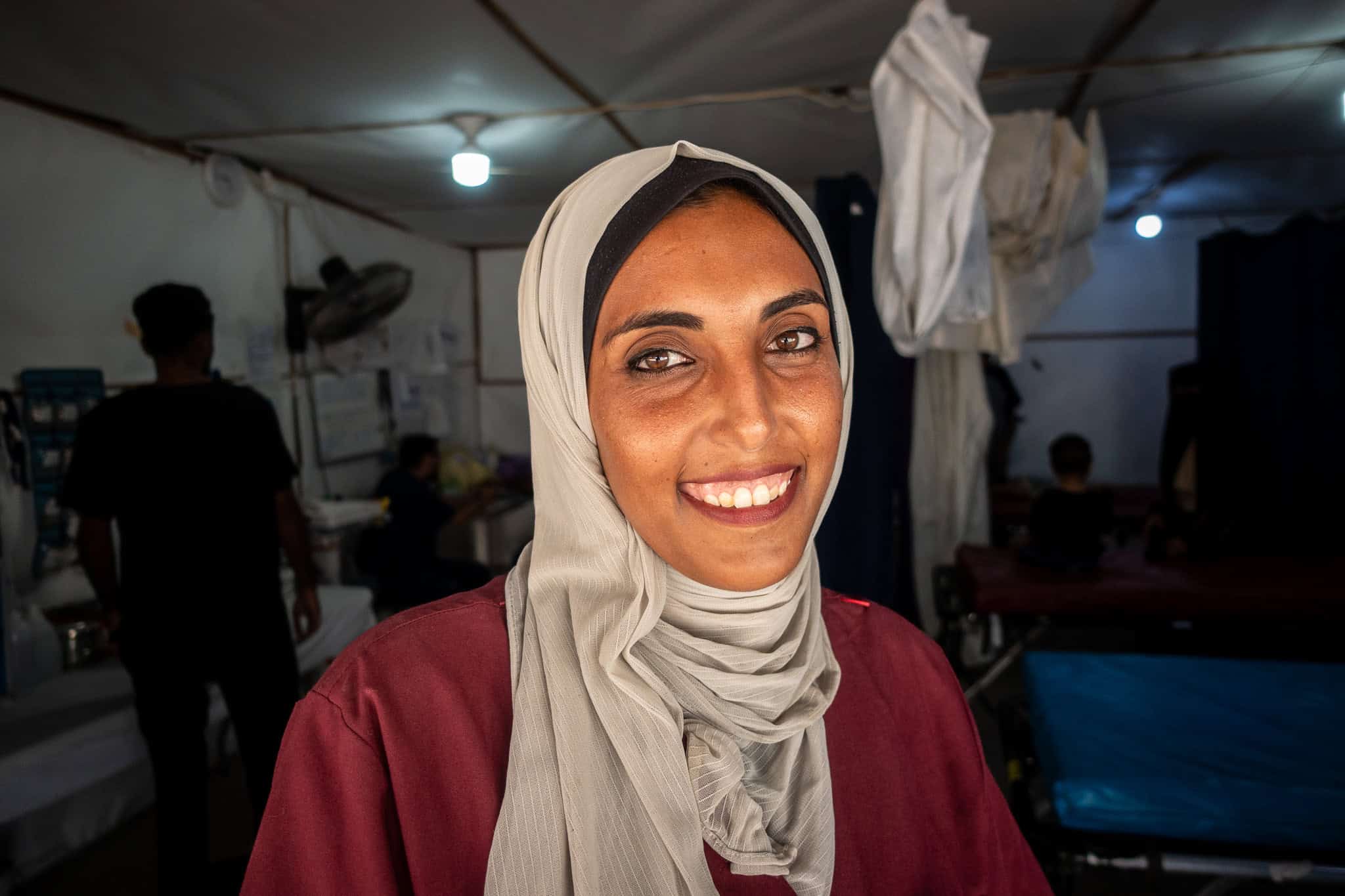


This year’s theme for World Health Day 2025 centres around maternal and newborn care; healthy beginnings, hopeful futures. With the ongoing uncertainties and increasingly volatile situation in Gaza affecting thousands of mothers, we are taking this opportunity to shine a light on the incredible work of the UK-Med maternal health department in Gaza. Despite the constant threat of the ongoing crisis, UK-Med staff are on hand to deliver vital pre- and post-natal care.
In these desperate circumstances, we strive for healthy beginnings so new mothers and babies can dream of a hopeful future.
Maternity care in Gaza
It is just over one year since midwife Faye Callaghan led the mission to set up UK-Med’s maternal health department in Gaza.
“The first challenge was deciding where to put the maternity department! It needed to be close to the operating theatre if caesareans were needed, near to washing facilities, have some privacy, and all this in what at the time was mostly a sandpit… We didn’t have all the supplies or equipment you would have in a UK maternity department, so improvisation was key, but ensuring a high quality of care was also vital.”
Our maternity department currently consists of tented wards with two halves: one for delivery and the other for inpatients, treating pregnant people with health concerns as well as mothers and babies post-delivery. We also have the mobile maternal care unit at the UK-Med field hospital which consists of a 40ft standard shipping container designed to facilitate Comprehensive Emergency Obstetric and Neonatal Care (CEmONC). It is fitted with an operation room, a recovery room and a storage/sterilisation room, and is staffed by an expert team of Palestinian midwives, with support from UK-Med’s international medics.
“The first Palestinian midwife I recruited was Mona. She was so calm, professional and compassionate. The best qualities of a midwife! Before we opened the labour ward, she started providing antenatal checks for women and made them feel at ease and cared for.”
Our facility is one of four field hospitals offering ante and postnatal care for an estimated 50,000 pregnant women in the Gaza Strip. The clinic and its midwives provide a beacon of hope – a safe place for mothers to give birth amid the ongoing humanitarian crisis.
“A woman arrived who was pregnant by IVF but hadn’t been able to see a doctor or a midwife for many months. She didn’t know if she was still pregnant. We listened to the baby’s heart rate together and she collapsed in tears, hugging me for at least ten minutes. It was such a simple thing I could do, but it brought her hope in a place of so much despair.” – Faye Callaghan UK-Med midwife
Healthy beginnings amongst conflict: A mother’s story
Almost 600 people have given birth at the UK-Med field hospital in Gaza since the maternity clinic opened in July last year, including Rasha. Like every new mother in Gaza, Rasha’s pregnancy took place against the backdrop of armed conflict, displacement, and hardship. After trying for six years to have a child, on 7th October 2024, exactly one year after the outbreak of conflict, she welcomed her baby girl – Ju’an – into the world.
“At the beginning I was worried about whether the tent would be safe for me to give birth, as there was no medicine or medical equipment. I didn’t know which hospital to go to, but I learned from the UK-Med community outreach team that they provided maternity services for mothers and their babies,” she said.
The ongoing trauma of the conflict, lack of food, temporary shelters and constant fear of violence and displacement is difficult for anyone, let alone someone carrying a baby.
“Pregnancy is already stressful but imagine being pregnant in a warzone”
“I was displaced twice when I was carrying my baby, and it caused me so much stress that I used to faint. I was so worried about my baby’s weight because I was struggling to find enough food.”
In her third trimester, Rasha started coming to the UK-Med field hospital for antenatal check-ups to monitor the health and well-being of her and her baby, after she lost access to her previous health clinic, run by UNRWA. Two months later, on 7th October, she gave birth at the mobile maternal care unit (CEmONC).
“The care was excellent. I’m so thankful for the midwives,” Rasha said.

Hopeful Futures in times of crisis
According to the World Health Organisation close to 300,000 women lose their life due to pregnancy or childbirth each year, while over 2 million babies die in their first month of life and around 2 million more are stillborn. That’s roughly 1 preventable death every 7 seconds.
Gaza is an example of how these tragic deaths are further exacerbated in crises. According to UNFPA, approximately 50,000 women in Gaza are pregnant, with a baby born every 10 minutes. These include an estimated 35 c-sections every day, and with the ongoing conflict, stress levels are significantly higher increasing the risk of premature births.
Thousands of expectant and new mothers are caught in a relentless cycle of exhaustion, trauma, and hunger. This poses significant risks not only the mother, but also the baby. The Human Rights Watch estimates that miscarriages have increased by 300%.
Renad, a Palestinian Midwife working with UK-Med in Gaza details her experience and the experience of many national medics on the ground:
“Being a midwife in Gaza means navigating through an unimaginable reality every day. Our healthcare system is strained beyond measure, resources are scarce, and every day brings new challenges…Despite these barriers, I am committed to providing the best care I can for mothers and newborns in need.”

During conflict, the health system is always affected, whether that’s due to an influx of patients on an already overstretched capacity, or the destruction of health infrastructure, medical needs increase and, with that, the resource to cope decreases.
This is what UK-Med can provide – response in times of urgent need, to support health systems and provide vital care that can contribute to hopeful futures.
Following the collapse of the ceasefire in Gaza, our teams are continuing to face increasingly challenging and volatile situations, with mass casualty incidents, lack of resources and displacement.
“Midwives, nurses, and doctors in Gaza work tirelessly, often risking our lives to support our community. It’s not just a job; it’s a mission for survival and hope.”
And it’s this mission UK-Med is determined to continue.